MARIE CLAIRE | interview
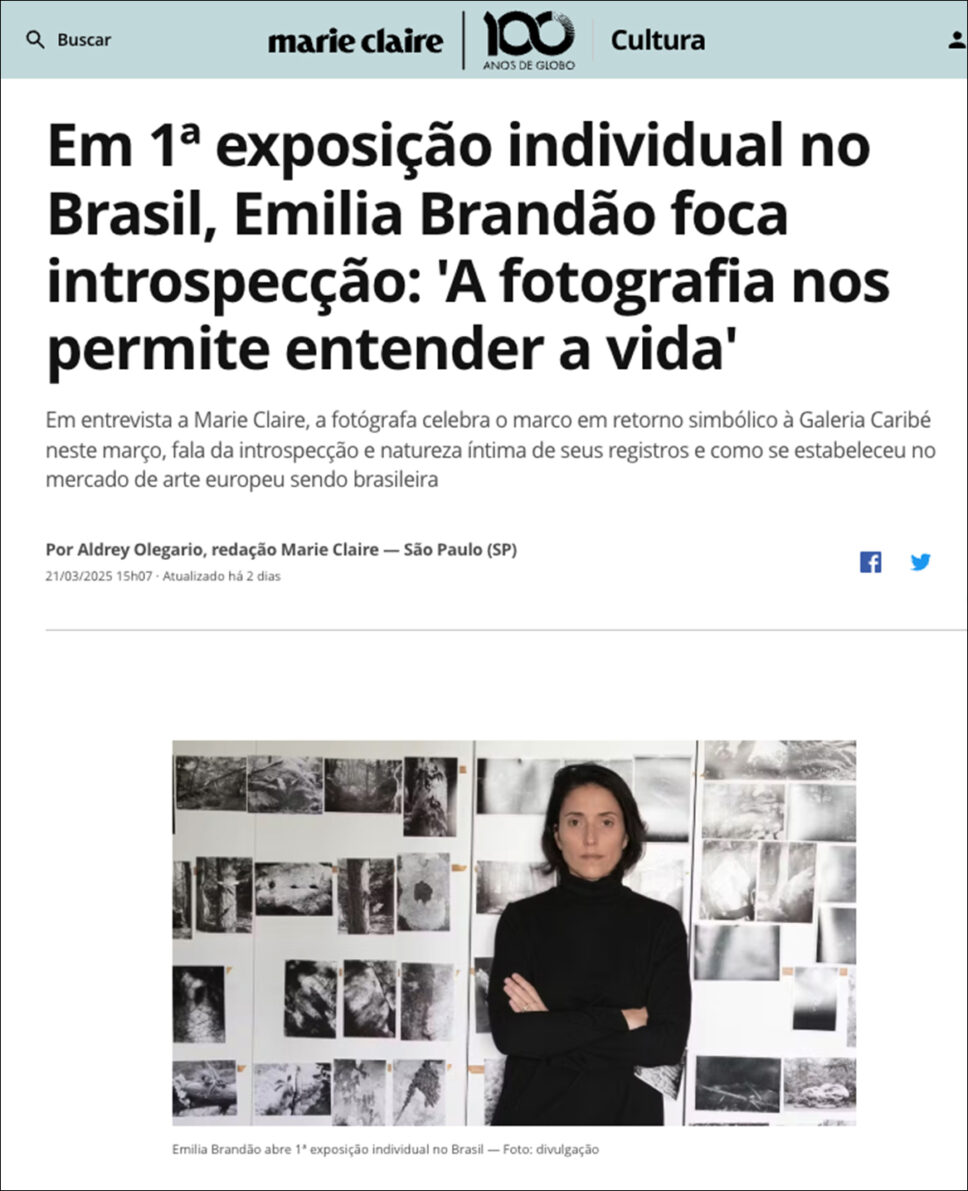
Marie Claire: in her first solo exhibition in Brazil, Emilia Brandão Carneiro focuses on introspection: “Photography allows us to understand life”.
In an interview with Marie Claire, the photographer celebrates a milestone with a symbolic return to Galeria Caribé this March, and talks about the introspective, intimate nature of her work and how she built a place for herself in the European art market as a Brazilian woman
Emilia Brandão Carneiro, a photographer from São Paulo, took up photography at 15 and sold her first photograph at 18 at Galeria Caribé, a gallery dedicated to modern and contemporary art. Today, at 42 and established in the European art market, she is preparing to reunite with the gallery through a milestone she considers especially meaningful: Acervo Migratório, her first solo exhibition in Brazil, opening on March 22. “It was a surprise to be welcomed this way, and this exhibition is a big bet,” she says.
Emilia has lived in Europe for 17 years. She left São Paulo for France in 2008 and has also lived in Spain and in Portugal, where she lives now. She says the decision to leave Brazil wasn’t easy, but that it was an inevitable desire. “I felt my soul needed to go to other places. I always knew my place was there,” she says.
The photographs in the exhibition were made between 2016 and 2022, and the show is curated by Luiza Testa. It comprises seven series: Pas des deux; Study of the sun; Paris glacial; Performance of a dream; When winter met spring; Sentimental journey and Berni. The images are introspective and capture Emília’s own intimacy, yet they still connect with other realities through the different ways she chooses to portray the constant, transitory and ephemeral movement of life, and the mystical side of nature. One example is the contrast between white snow and the pink petals of cherry blossoms, used to show winter turning into spring in the series When winter met spring, photographed in Paris.
“This is the first time I’m bringing practically my entire body of work to Brazil. These stories are very much part of my personal journey as an artist, but migration runs through all of them. I hadn’t even realized it, but it was something I was always trying to understand and reflecting on. In the series about the horse [Berni (2020–2022)], for example, he’s a retired show jumper, migrating from his life as an athlete to the end of his life,” she says.
“Just because we live in one place doesn’t mean our work has to live there too. My work will be wherever it is well received, and I’ll be wherever I feel welcome. And I understood that Brazil was welcoming my work. I’m so happy to be making this move of coming back home.”
The photographer shares that establishing herself in a European market as a Brazilian was challenging. “Everyone knows that making a living from art is very hard. Europe has a very cruel art market, because once again you go back to being the immigrant woman. In Brazil, we practically embrace anyone who arrives from outside, and over there it isn’t like that. There’s a trust problem with immigrants,” she observes. “Until they trust you, give you an opportunity and you build your contacts, you have to work incredibly hard. But I knew what I was getting into, and I wasn’t going to give up.”
Presenting herself to galleries with experimental photography, working mostly in grayscale, Brandão quickly noticed the gap between her aesthetic and what was circulating in the market at the time. “In Spain there was a demand for an aesthetic very much like [Pedro] Almodóvar’s: expressive, vivid colors, more performance-driven and with a plasticity that’s very easy to understand,” she says. “My work was the opposite: totally poetic, mysterious and introspective, in a way that even makes people uncomfortable, because it makes you look at things you suddenly may not want to see. I learned a lot from that,” she continues.
She explains part of these self-discovery images during her interview with Marie Claire, held over a video call from her home in Portugal. Right behind Emilia hangs an image of a ballerina in an arabesque, with her supporting foot resting on one of the columns of a balustrade. The dancer is Brazilian Marina Droghetti, with whom the photographer has built a bond she is proud of. “That was the first time we met in person, in 2017, at Parc Monceau in Paris, which we both love. Marina is like my muse, we’re very close friends and every time we meet it’s an explosion of creativity. In the exhibition, this photo will be at the very back of the gallery, like a grand finale,” explains Emilia about the photo, part of the series Pax de Deux 1.
In Sentimental journey, which she names as one of her most significant works, it is swans on the Seine that catch Emilia’s eye. “It was a very hard moment in my life. I had just become a mother, and I lost my father in a car accident. What helped me find myself and bring everything back into balance was a walk around that island, and those swans were always there. For me, they’ve always been a symbol of majesty, and being around them felt almost utopian. What I felt there was a grand sense of protection,” she recalls of the roughly three years during which she made the series. “I photographed them without much artistic intention, it was more a need to record that. When I left France in 2019, I thought: ‘I wouldn’t have survived if it weren’t for those swans,'” she continues.
‘Photography is a vehicle that allows us to understand life’
Emilia’s career carries the experience of someone who lived through the shift from analog to digital photography. The first time she fired a digital camera was on the set of Bob Wolfenson, the renowned Brazilian photographer. “I was a photography assistant and he asked me to shoot the making of for the campaign. He was photographing Gisele Bündchen,” she remembers. “Bob is a very observant photographer. Watching him interact with people, I learned the importance of charisma in the moment you meet someone. Making the moment as casual as possible. That says a lot about the nature of portraiture.”
Looking at the market then and comparing it with today’s, she sees significant changes, especially regarding women’s place in the field. “It wasn’t a female world. When I started working as a professional photographer, the environment was hostile. But I insisted and I didn’t give up,” she says. “I think digital photography made things more democratic,” she adds.
Through her portraits, Emilia has worked with Brazilian magazines and also earned prestige in the European media. With the series Time to heal (2020), which led Leica, the German camera brand, to invite her to become one of its ambassadors, she photographed the faces of 150 healthcare workers from 33 hospitals in Madrid, Spain, during the first months of the COVID-19 pandemic. She plans to turn the tribute into a book and publish it later this year. “I had never photographed pain like that before. But I felt I needed to show those faces and those stories,” she says. “My intention was always that these photos would stand as a landmark in history. I have no words to describe the work these people did inside the hospitals. They were isolated, with no contact even with their own families. When they came in, they would open up. It was very cathartic,” she reflects.
For the portraitist, taking a photo is a way out of restlessness. “For me it’s like a diary, something I need to write in so I can keep going with my life,” she defines. “Photography is a vehicle that allows us to understand life. As a photographer, I seek, visually, to translate and communicate a story.”